Philadelphia, 1872-1899
The Keely Motor, archived without mythmaking.
John Worrell Keely promised a motor powered by a new etheric or sympathetic vibratory force. Investors funded the Keely Motor Company for decades. The machine never became a practical engine, and after Keely's death investigators reported hidden tubes, a water motor, and compressed-air apparatus.
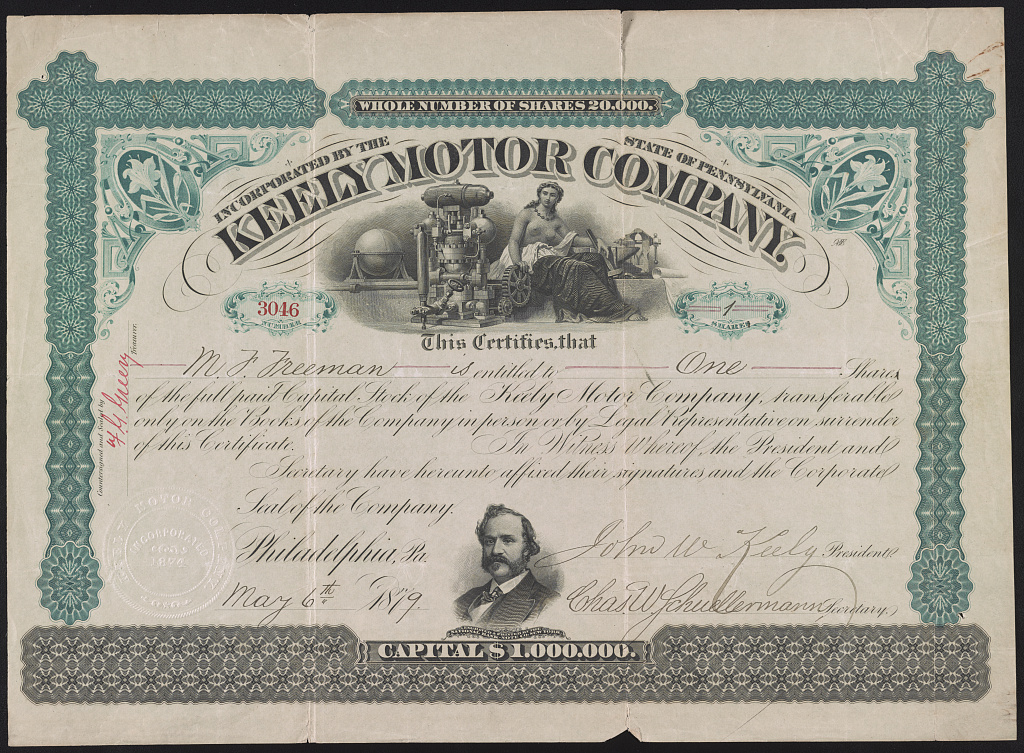
The company sold a technological future as much as it sold a machine. This 1879 certificate is preserved by the Library of Congress.
Library of Congress, public-domain image
Company
1874
Incorporation date given by Gale's reference entry.
Aftermath
1899
Post-mortem laboratory investigation and press expose.
Key facts
- The Keely Motor was a real company and demonstration phenomenon, not a verified new power source.
- The strongest evidence after 1899 points to hidden conventional power, not sympathetic-vibratory physics.
- This archive focuses on the machine, company, demonstrations, and sources; biography lives at johnkeely.com.
Evidence at a glance
What can be said safely?
The claim
Keely described a new motive force from water, air, ether, and sympathetic vibration, with terminology that shifted across decades.
The business
The Keely Motor Company raised money, issued stock, and fought for disclosure, but no marketable motor emerged.
The expose
After Keely died in 1898, reporters and technical witnesses documented concealed apparatus consistent with ordinary hidden power.
Start here
Read the machine story, not just the biography.
For Keely's life, family, and broader evidence map, use the sibling biography sitejohnkeely.com. This archive stays with the machine, the company, the demonstrations, and the evidence.
The machines
Generator, liberator, vacuo-engine, vibratory microscope claims, and surviving or illustrated apparatus.
The demonstrations
What witnesses saw, what was controlled, and what was kept out of view.
The company
Incorporation, stock promotion, investor pressure, lawsuits, and Clara Bloomfield Moore.
The 1899 expose
The posthumous investigation, hidden tubing, water motor, sphere, and company denials.
Timeline snapshot
The Keely Motor story is best read as a sequence of public claims, private demonstrations, investor patience, legal pressure, and posthumous inspection. Keely's birth year is itself a source problem: the brief requests 1827 and some memorial sources use it, while several modern references and an 1898 obituary imply 1837. The timeline page records the discrepancy directly.
- 1872: Keely's early hydro-vacuo / hydro-pneumatic patent language appears in later historical accounts.
- 1874: The Keely Motor Company is incorporated to promote the claimed force.
- 1880s: Stockholders press for disclosure; demonstrations and lawsuits keep public attention alive.
- 1893: Clara Bloomfield Moore publishes a major supporter account.
- 1898-1899: Keely dies; the lab investigation reframes the motor as a hidden-power fraud.

The posthumous investigation shifted attention from etheric force to hidden infrastructure: tubes, concealed spaces, and this reported three-ton sphere.
New York Journal and Advertiser via Wikimedia Commons, public domain
Sources used on this page
Robert MacDougall, Sympathetic Physics (Technology and Culture, 2019)
Modern history-of-technology analysis of the motor, stock promotion, thermodynamics debate, and Clara Moore.
Gale Encyclopedia entry on John Ernst Worrell Keely
Concise reference for incorporation, devices, supporters, death, and posthumous fraud findings.
National Endowment for the Humanities, The Etheric Force Machine
Short institutional overview of the American Precision Museum object and the hidden compressed-air explanation.
Clara Bloomfield Moore, Keely and His Discoveries (1893)
Public-domain supporter account and primary witness to the late sympathetic-vibratory framing around Keely.
Library of Congress, Keely Motor Company stock certificate
Public-domain 1879 engraved Keely Motor Company certificate published by National Bank Note Company.
Related